Scales as Harmonic Tools
Summary
Scales are often taught as finger patterns, but their real purpose is to support harmony and musical direction. This guide reframes scales as harmonic tools rather than exercises. By understanding how major, minor, and pentatonic scales relate to tonal centers and chord movement, players can use scales intentionally instead of running patterns. The circle of fifths is introduced as a map for understanding these relationships.
Videos
Scales and Harmony
A scale is a collection of notes that defines which sounds are available within a tonal context. Scales do not create harmony on their own, but they describe the note environment that harmony lives inside. When used intentionally, scales help players choose notes that support chord movement and musical direction.
Major, Minor, and Pentatonic Scales
Major and minor scales define the tonal center and emotional character of music. They provide a full set of notes that describe stability, tension, and resolution. Pentatonic scales are simplified versions that remove some of the more unstable tones, making them especially useful for melodic clarity and groove-based playing on bass and guitar.
Pentatonic scales are not replacements for major or minor scales, but tools that highlight strong, stable relationships within a key.
Scales Supporting Chords
Scales gain meaning when they are connected to chords. Notes from a scale can be used to outline chord tones, create passing motion, or add color depending on the harmonic context. Understanding this relationship helps players avoid treating scales as independent shapes disconnected from the music.
The Circle of Fifths
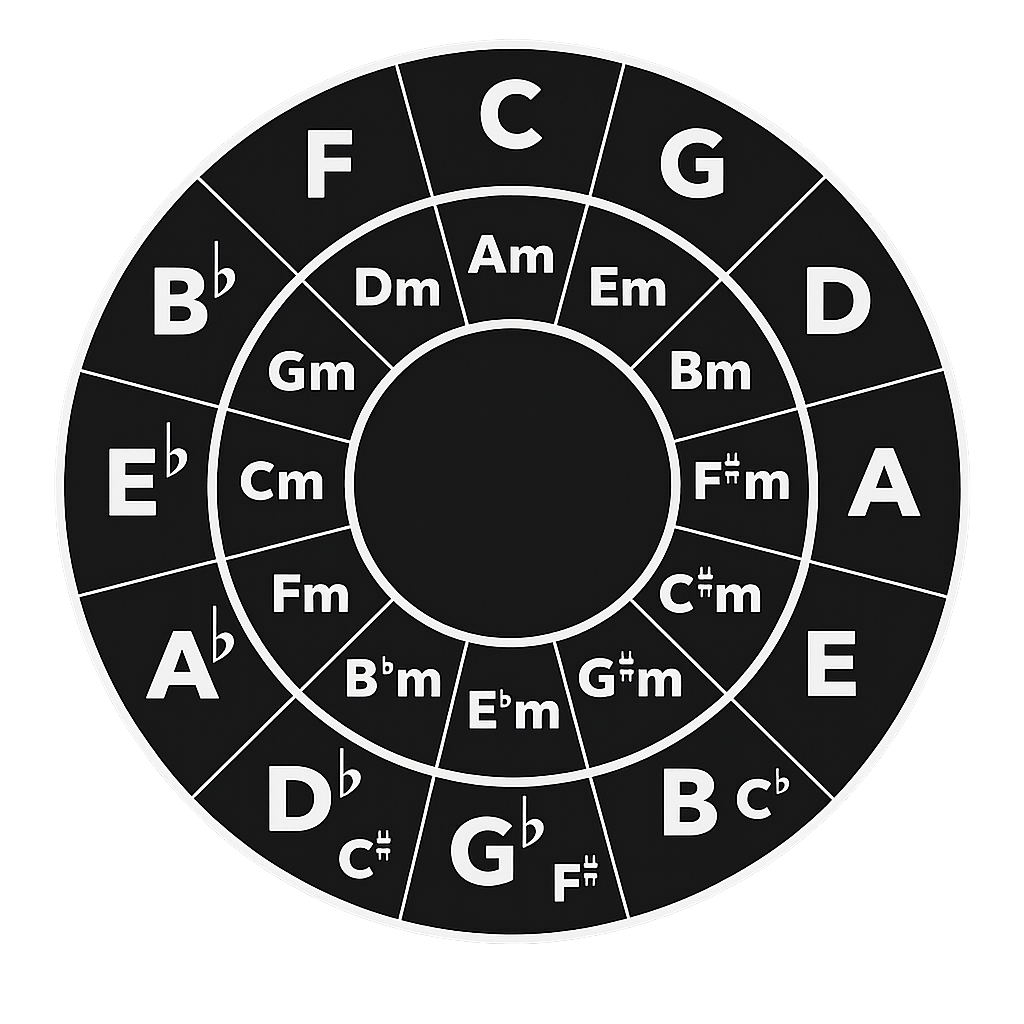
The circle of fifths is a visual map that shows how keys, scales, and harmony are related. Moving clockwise represents ascending fifths, while counterclockwise represents descending fifths. Closely related keys appear near each other on the circle, helping players understand why certain chord movements sound natural.
For bass and guitar players, the circle of fifths helps explain common progressions, key changes, and why certain scales fit naturally over specific harmonic movement.
Application on Bass and Guitar
On bass, scales help connect chord tones smoothly and support harmonic movement. On guitar, scales inform melodic phrasing and chord-based improvisation. In both cases, scales function best when used to reinforce harmony rather than replace it.
Lessons and References
Keywords
- scales
- major scale
- minor scale
- pentatonic
- circle of fifths
- harmony
- tonal center
Related Topics
- What Harmony Does
- Chords as Function, Not Shapes
- Arpeggios and Chord Tones
One-on-One
One-on-one instruction helps connect scales directly to harmonic situations, showing how to apply major, minor, and pentatonic scales intentionally in real music on bass and guitar.